Basic Electrical and Electronics Engineering: Unit V: Measurements and Instrumentation
Thermocouple Instrument
Construction, Operation Principle, Diagram, Torque equation, Error, Advantages, Disadvantage
It is used for the measurement of both AC and DC.It gives very accurate output about 50MHZ.It consist of two parts1. Thermoelectric element and 2. indicating instrument.
THERMOCOUPLE
INSTRUMENT
It
is used for the measurement of both AC and DC.
It
gives very accurate output about 50MHZ.
It
consist of two parts
1.
Thermoelectric element and 2. indicating instrument.
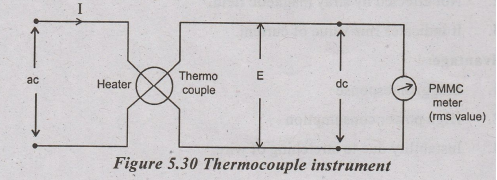
The
current to be measured is pass through the heater element. It produces heat.
This heat is sensed by a thermocouple placed near to the heater. Thermocouple
works on the principle of seebeck effect and produces emf in MV range.
Here
PMMC meter forms the indicating instrument. Because the output of Thermocouple
is DC. The meter indicates the rms value of the current.
This
measuring Thermocouple is placed in one arm of a bridge circuit. It produces
deflection in the Galvanometer. Feedback is taken and given to another heater
element. This heater element is sensed by a compensating thermocouple placed in
another arm of the bridge circuit. So this nullifies the meter movement. Now
the output dc emf value is the original indication of measured current.
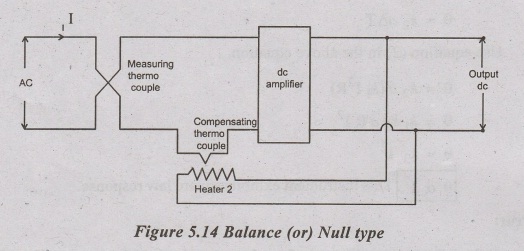
This
arrangement is used to eliminate the non linear behaviour of Thermocouple.
Torque equation:-
Thermal
emf developed in the circuit is given by
E
= a (T1-T2) + b (T1 - T2)2
……….(1)
where
T1 is the temperature of hot junction in °C.
T2
is the temperature of cold junction in °C.
a
and b are thermocouple constants.
Change
in temperature, ΔT = (T1-T2)
Heat
α I2 R
Heat
is given by rise in temperature or ΔT.
ΔT
α I2 R
ΔT
= K I2R …..... (2)
Deflection
of PMMC meter Ɵ = k2 E
From
equation (1) put the value of E
Ɵ
= k2 [aΔT + bΔT2]
since
b is very small neglect the second term.
Ꮎ = k2
α ΔT
Use
equation (2) in the above equation.
Ꮎ = k2
a (k1 I2R)
Ꮎ = k1
k2 a R I2
Ꮎ = k3
I2
Ꮎ α I2
This instrument exhibits square law response.
Error:
At
high frequency current is forced to pass through the outer surface of the
conductor. Because the reactance of the inner parts of the conductor is greater
than the outer parts. This increases the resistance. This effect is called skin
effect.
Heater
is suffer from skin effect. In order to eliminate this effect, heater wires are
designed with small crossectional area or a fine non magnetic material with
very high resistivity is used for making heater elements.
Advantages:
1.
High sensitivity
2.
Used for the measurement of both AC and DC.
3.
Frequency error, stray magnetic field errors are absent.
4.
Very accurate for frequency greater than 50MHZ.
5.
Current range is 0.5 to 20A.
6.
It indicates rms value of current.
7.
It gives accurate output for complex waveforms like non sinusoidal inputs,
distorted or noisy inputs
Disadvantage:
1.
Overload capacity is small.
2.
At normal rated current, heater attains a temperature of 300 °C. So heater
blows out before fuse blows.
Basic Electrical and Electronics Engineering: Unit V: Measurements and Instrumentation : Tag: : Construction, Operation Principle, Diagram, Torque equation, Error, Advantages, Disadvantage - Thermocouple Instrument
Basic Electrical and Electronics Engineering: Unit V: Measurements and Instrumentation
Under Subject
Basic Electrical and Electronics Engineering
BE3251 2nd semester Mechanical Dept | 2021 Regulation | 2nd Semester Mechanical Dept 2021 Regulation
Basic Electrical and Electronics Engineering
BE3251 2nd Semester CSE Dept 2021 | Regulation | 2nd Semester CSE Dept 2021 Regulation
Related Subjects

Professional English II
HS3251 2nd Semester 2021 Regulation | 2nd Semester Common to all Dept 2021 Regulation
Statistics and Numerical Methods
MA3251 2nd Semester 2021 Regulation M2 Engineering Mathematics 2 | 2nd Semester Common to all Dept 2021 Regulation

Engineering Graphics
GE3251 eg 2nd semester | 2021 Regulation | 2nd Semester Common to all Dept 2021 Regulation
Physics for Electrical Engineering
PH3202 2nd Semester 2021 Regulation | 2nd Semester EEE Dept 2021 Regulation
Basic Civil and Mechanical Engineering
BE3255 2nd Semester 2021 Regulation | 2nd Semester EEE Dept 2021 Regulation
Electric Circuit Analysis
EE3251 2nd Semester 2021 Regulation | 2nd Semester EEE Dept 2021 Regulation
Physics for Electronics Engineering
PH3254 - Physics II - 2nd Semester - ECE Department - 2021 Regulation | 2nd Semester ECE Dept 2021 Regulation
Electrical and Instrumentation Engineering
BE3254 - 2nd Semester - ECE Dept - 2021 Regulation | 2nd Semester ECE Dept 2021 Regulation
Circuit Analysis
EC3251 - 2nd Semester - ECE Dept - 2021 Regulation | 2nd Semester ECE Dept 2021 Regulation
Materials Science
PH3251 2nd semester Mechanical Dept | 2021 Regulation | 2nd Semester Mechanical Dept 2021 Regulation
Basic Electrical and Electronics Engineering
BE3251 2nd semester Mechanical Dept | 2021 Regulation | 2nd Semester Mechanical Dept 2021 Regulation

Physics for Civil Engineering
PH3201 2021 Regulation | 2nd Semester Civil Dept 2021 Regulation
Basic Electrical, Electronics and Instrumentation Engineering
BE3252 2021 Regulation | 2nd Semester Civil Dept 2021 Regulation
Physics for Information Science
PH3256 2nd Semester CSE Dept | 2021 Regulation | 2nd Semester CSE Dept 2021 Regulation
Basic Electrical and Electronics Engineering
BE3251 2nd Semester CSE Dept 2021 | Regulation | 2nd Semester CSE Dept 2021 Regulation
Programming in C
CS3251 2nd Semester CSE Dept 2021 | Regulation | 2nd Semester CSE Dept 2021 Regulation