Basic Electrical and Electronics Engineering: Unit V: Measurements and Instrumentation
Electrostatic Instrument
Construction, Operation Principle, Diagram, Torque equation, Advantages, Disadvantage
This instrument is used for both AC and DC measurement. This instrument has high resistance, so draws less current from the circuit and the force generated will be small.
ELECTROSTATIC
INSTRUMENT
This
instrument is used for both AC and DC measurement. This instrument has high
resistance, so draws less current from the circuit and the force generated will
be small. This instrument is best suited for voltage measurement. Voltage
ranges from 100V to 20KV.
Principle:-
This
instrument uses Electrostatic principle for producing deflection.
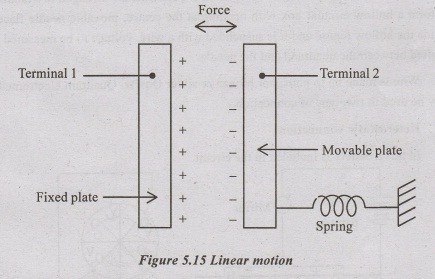
It
consist of two plates one is fixed and the another one is movable voltage is
applied between fixed and movable plate. Due to the accumulation of changes on
the two plates, a force is generated, this force may be attractive or repulsive
in nature. This cause the movable plate to be in motion. Motion may be linear
or rotary based on the structure of the plate.

Quadrant Electrometer:
It
is a type of Electrostatic instrument.
It
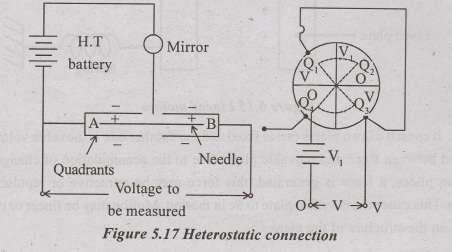
consist of two fixed Quadrants and the Quadrants are arranged in a manner to
form a hollow circular box with opening at the centre, movable needle flaced
inside the hollow region and it is suspended with a wire. voltage to be
measured is applied between the quadrand and the needle.
Wire
is made up to phosphor bronze or silver Quartz. Quadrant electrometer may be
used in two type of connection.
1.
Heterostatic connection:
In
this a battery is included in the circuit.
2.
Idiostatic connection:


Torque equation:
When
the voltage is being increased a capacitive current flows.
i
= dq/dt = d(cv)/dt = c dv/dt + v dc/dt
multiply
by vdt on both sides we get the input energy,
vidt
= vc dv/dt . dt + v2 dc/dt .dt
vidt
= vc dv + v2 dc ……….(1)
Energy
stored = ½ cv2
Where
'c' is the capacitance between the two plates.
'v'
is the voltage to be measured.
Change
in stored energy = [ ½ (c + dc) (v + dv)2] - [ ½ cv2]
=
[ ½ (c + dc) (v2 + dv2 + 2vdv) ] = ½ cv2
=
½ cv2 + ½ cdv2 + ½ c(2vdv) + ½ v2 dc + ½ dcdv2
+ ½ dc(2vdv) – ½ cv2
Neglect
are the higher order terms as they smaller quantities,
=
½ v2 dc + cvdv ………..(2)
By
the principle of conservation of energy,
input
electrical energy = change in stored energy + mechanical work done
Equation
(1) = Equation (2) + Td dƟ
cvdv
+ v2 dc = ½ v2dc + cvdv + Td . dƟ
Td
. dƟ = v2dc - ½ v2dc
=
½ v2dc
Td
= ½ v2 dc/dƟ
controlling
torque is given by the spring
Tc
= kᎾ
For
final steady state deflection, Tc = Td
kᎾ = ½ v2
dc/dƟ
Ꮎ = ½ v2/k
dc/dƟ
This
instrument exhibits a square law response so it has non uniform scale.
Extension of meter range:
Range
of Electrostatic instrument is extended by two methods.
1.
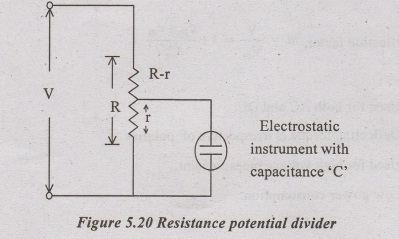
Resistance potential divider:
The
voltage to be measured (V) is connected to the resistance 'R' The electrostatic
instrument whose range is to be extended is connected to a portion of the
resistor.
multiplication
factor, m = R/r
2.
Capacitor multiplier
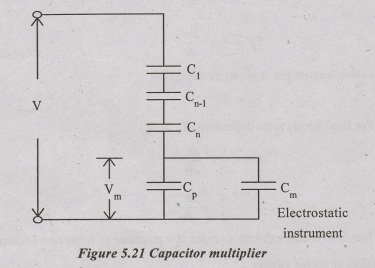
Here
C1, C2, ……. Cn-1, Cn and Cp
are set of series multiplier capacitors. Electrostatic instrument is connected
across any one of these multiplying capacitors.
The
equivalent capacitance,
1/Cseries
= 1/c1 + 1/c2 + ……. + 1/cn-1 + 1/cn
and
Cv = Cp+ Cm
multiplication
factor, m = V/Vm = 1+ (cp + cm)/Cs
Advantages:
1.
Used for both AC and DC.
2.
Deflecting torque is irrespective of polarity
3.
Used for high voltage measurement.
4.
Low power consumption.
Disadvantages:
1.
Operating force is small
2.
Non uniform scale.
3.
High cost
4.
Large size
Basic Electrical and Electronics Engineering: Unit V: Measurements and Instrumentation : Tag: : Construction, Operation Principle, Diagram, Torque equation, Advantages, Disadvantage - Electrostatic Instrument
Basic Electrical and Electronics Engineering: Unit V: Measurements and Instrumentation
Under Subject
Basic Electrical and Electronics Engineering
BE3251 2nd semester Mechanical Dept | 2021 Regulation | 2nd Semester Mechanical Dept 2021 Regulation
Basic Electrical and Electronics Engineering
BE3251 2nd Semester CSE Dept 2021 | Regulation | 2nd Semester CSE Dept 2021 Regulation
Related Subjects

Professional English II
HS3251 2nd Semester 2021 Regulation | 2nd Semester Common to all Dept 2021 Regulation
Statistics and Numerical Methods
MA3251 2nd Semester 2021 Regulation M2 Engineering Mathematics 2 | 2nd Semester Common to all Dept 2021 Regulation
Engineering Graphics
GE3251 eg 2nd semester | 2021 Regulation | 2nd Semester Common to all Dept 2021 Regulation

Physics for Electrical Engineering
PH3202 2nd Semester 2021 Regulation | 2nd Semester EEE Dept 2021 Regulation
Basic Civil and Mechanical Engineering
BE3255 2nd Semester 2021 Regulation | 2nd Semester EEE Dept 2021 Regulation
Electric Circuit Analysis
EE3251 2nd Semester 2021 Regulation | 2nd Semester EEE Dept 2021 Regulation

Physics for Electronics Engineering
PH3254 - Physics II - 2nd Semester - ECE Department - 2021 Regulation | 2nd Semester ECE Dept 2021 Regulation
Electrical and Instrumentation Engineering
BE3254 - 2nd Semester - ECE Dept - 2021 Regulation | 2nd Semester ECE Dept 2021 Regulation
Circuit Analysis
EC3251 - 2nd Semester - ECE Dept - 2021 Regulation | 2nd Semester ECE Dept 2021 Regulation

Materials Science
PH3251 2nd semester Mechanical Dept | 2021 Regulation | 2nd Semester Mechanical Dept 2021 Regulation
Basic Electrical and Electronics Engineering
BE3251 2nd semester Mechanical Dept | 2021 Regulation | 2nd Semester Mechanical Dept 2021 Regulation
Physics for Civil Engineering
PH3201 2021 Regulation | 2nd Semester Civil Dept 2021 Regulation
Basic Electrical, Electronics and Instrumentation Engineering
BE3252 2021 Regulation | 2nd Semester Civil Dept 2021 Regulation

Physics for Information Science
PH3256 2nd Semester CSE Dept | 2021 Regulation | 2nd Semester CSE Dept 2021 Regulation
Basic Electrical and Electronics Engineering
BE3251 2nd Semester CSE Dept 2021 | Regulation | 2nd Semester CSE Dept 2021 Regulation
Programming in C
CS3251 2nd Semester CSE Dept 2021 | Regulation | 2nd Semester CSE Dept 2021 Regulation