Basic Electrical and Electronics Engineering: Unit I: Electrical Circuits
Ohms Law in Electrical Circuits
Statement, Formula, Limitations, Example Problems
When a voltage is applied to a closed circuit, it causes flow of electrons and a current in the circuit.
OHMS
LAW
When
a voltage is applied to a closed circuit, it causes flow of electrons and a
current in the circuit. The resistance of the circuit opposes the flow of
current. The actual value of the current flowing depends on the applied emf and
resistance in the circuit, the relationship is given by ohm's law.
Statement of ohms law:
The
potential difference (or) voltage across any two ends of a conductor is
directly proportional to the current flowing through it, provided that the
temperature of the conductor remains constant.
Mathematically,
we can write,
V
α I (Temperature is constant)
V
= IR
Where
R
is constant, becomes the resistance
V
is in volts and
I
is in amperes.
Limitations:
(i)
It cannot be applied to non metallic conductors.
(ii) It cannot be applied to non linear devices such as zener diode, voltage regulator,etc.
(iii)
It is applicable for constant temperature only. If the temperature changes,
this law cannot be applied.
Example: 1
An electric heater draws 8A from
250V supply. What is its power rating?
Also find the resistance of the
heater element.
Power
rating = V.I
=
250 × 8
=
2000 W
Resistance
= V/I = 250/8 Ω
=
31.25 Ω
Example: 2
A 5Ω resistor has a voltage rating of 100 V. What is its power rating?
P
= V2/R
=
1002/5
=2000
W
Basic Electrical and Electronics Engineering: Unit I: Electrical Circuits : Tag: : Statement, Formula, Limitations, Example Problems - Ohms Law in Electrical Circuits
Basic Electrical and Electronics Engineering: Unit I: Electrical Circuits
Under Subject
Basic Electrical and Electronics Engineering
BE3251 2nd semester Mechanical Dept | 2021 Regulation | 2nd Semester Mechanical Dept 2021 Regulation
Basic Electrical and Electronics Engineering
BE3251 2nd Semester CSE Dept 2021 | Regulation | 2nd Semester CSE Dept 2021 Regulation
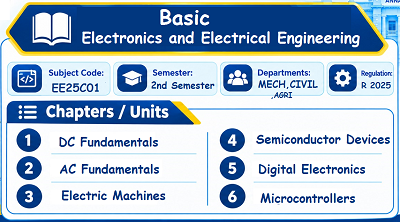
Basic Electrical and Electronics Engineering
EE25C01 2nd Semester | 2025 Regulation | 2nd Semester 2025 Regulation
Related Subjects
Professional English II
HS3251 2nd Semester 2021 Regulation | 2nd Semester Common to all Dept 2021 Regulation
Statistics and Numerical Methods
MA3251 2nd Semester 2021 Regulation M2 Engineering Mathematics 2 | 2nd Semester Common to all Dept 2021 Regulation
Engineering Graphics
GE3251 eg 2nd semester | 2021 Regulation | 2nd Semester Common to all Dept 2021 Regulation
Physics for Electrical Engineering
PH3202 2nd Semester 2021 Regulation | 2nd Semester EEE Dept 2021 Regulation
Basic Civil and Mechanical Engineering
BE3255 2nd Semester 2021 Regulation | 2nd Semester EEE Dept 2021 Regulation
Electric Circuit Analysis
EE3251 2nd Semester 2021 Regulation | 2nd Semester EEE Dept 2021 Regulation
Physics for Electronics Engineering
PH3254 - Physics II - 2nd Semester - ECE Department - 2021 Regulation | 2nd Semester ECE Dept 2021 Regulation
Electrical and Instrumentation Engineering
BE3254 - 2nd Semester - ECE Dept - 2021 Regulation | 2nd Semester ECE Dept 2021 Regulation
Circuit Analysis
EC3251 - 2nd Semester - ECE Dept - 2021 Regulation | 2nd Semester ECE Dept 2021 Regulation
Materials Science
PH3251 2nd semester Mechanical Dept | 2021 Regulation | 2nd Semester Mechanical Dept 2021 Regulation
Basic Electrical and Electronics Engineering
BE3251 2nd semester Mechanical Dept | 2021 Regulation | 2nd Semester Mechanical Dept 2021 Regulation
Physics for Civil Engineering
PH3201 2021 Regulation | 2nd Semester Civil Dept 2021 Regulation
Basic Electrical, Electronics and Instrumentation Engineering
BE3252 2021 Regulation | 2nd Semester Civil Dept 2021 Regulation
Physics for Information Science
PH3256 2nd Semester CSE Dept | 2021 Regulation | 2nd Semester CSE Dept 2021 Regulation
Basic Electrical and Electronics Engineering
BE3251 2nd Semester CSE Dept 2021 | Regulation | 2nd Semester CSE Dept 2021 Regulation
Programming in C
CS3251 2nd Semester CSE Dept 2021 | Regulation | 2nd Semester CSE Dept 2021 Regulation