Artificial Intelligence and Machine Learning: Unit V: Neural Networks
Gradient Descent Optimization
Neural Networks - Artificial Intelligence and Machine Learning
Gradient Descent is an optimization algorithm in gadget mastering used to limit a feature with the aid iteratively moving towards the minimal fee of 1979 the characteristic.
Gradient
Descent Optimization
•
Gradient Descent is an optimization algorithm in
gadget mastering used to limit a feature with the aid iteratively moving
towards the minimal fee of the characteristic.
• We essentially use this algorithm when we have to locate
the least possible values which could fulfill a given fee function. In gadget
getting to know, greater regularly that not we try to limit loss features (like
Mean Squared Error). By minimizing the loss characteristic, we will improve our
model and Gradient Descent is one of the most popular algorithms used for this
cause.
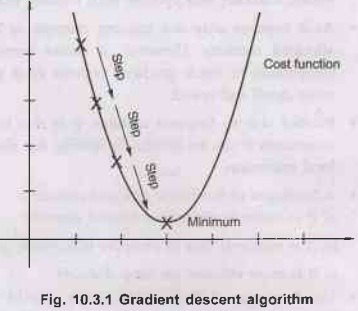
•
The graph above shows how exactly a Gradient Descent
set of rules works.
•
We first take a factor in the value function and
begin shifting in steps in the direction of the minimum factor. The size of
that step, or how quickly we ought to converge to the minimum factor is defined
by Learning Rate. We can cowl more location with better learning fee but at the
risk of overshooting the minima. On the opposite hand, small steps/smaller
gaining knowledge of charges will eat a number of time to attain the lowest
point.
•
Now, the direction wherein algorithm has to transport
(closer to minimal) is also important. We calculate this by way of using
derivatives. You need to be familiar with derivatives from calculus. A spin off
is largely calculated because the slope of anon the graph at any specific
factor. We get that with the aid of finding the tangent line to the graph at
that point. The extra steep the tangent, would suggest that more steps would be
needed to reach minimum point, much less steep might suggest lesser steps are
required to reach the minimum factor.
Stochastic Gradient Descent
•
The word 'stochastic' means a system or a process
that is linked with a random probability. Hence, in Stochastic Gradient
Descent, a few samples are selected randomly instead of the whole data set for
each iteration.
•
Stochastic Gradient Descent (SGD) is a type of
gradient descent that runs one training example per iteration. It processes a
training epoch for each example within a dataset and updates each training
example's parameters one at a time.
•
As it requires only one training example at a time,
hence it is easier to store in allocated memory. However, it shows some
computational efficiency losses in comparison to batch gradient systems as it
shows frequent updates that require more detail and speed.
•
Further, due to frequent updates, it is also treated
as a noisy gradient. However, sometimes it can be helpful in finding the global
minimum and also escaping the local minimum.
•
Advantages of Stochastic gradient descent:
a)
It is easier to allocate in desired memory.
b)
It is relatively fast to compute than batch gradient descent.
c) It
is more efficient for large datasets.
•
Disadvantages of Stochastic Gradient Descent:
a)
SGD requires a number of hyper parameters such as the regularization parameter
and the number of iterations.
b)
SGD is sensitive to feature scaling.
Artificial Intelligence and Machine Learning: Unit V: Neural Networks : Tag: : Neural Networks - Artificial Intelligence and Machine Learning - Gradient Descent Optimization
Artificial Intelligence and Machine Learning: Unit V: Neural Networks
Under Subject
Artificial Intelligence and Machine Learning
CS3491 4th Semester CSE/ECE Dept | 2021 Regulation | 4th Semester CSE/ECE Dept 2021 Regulation
Artificial Intelligence and Machine Learning
EC25401 4th Semester ECE Department | 2025 Regulation | 4th Semester 2025 Regulation
Related Subjects

Environmental Sciences and Sustainability
GE3451 ESS 4th Semester | 2021 Regulation | 4th Semester EEE Dept 2021 Regulation
Theory of Computation
CS3452 4th Semester CSE Dept | 2021 Regulation | 4th Semester CSE Dept 2021 Regulation
Artificial Intelligence and Machine Learning
CS3491 4th Semester CSE/ECE Dept | 2021 Regulation | 4th Semester CSE/ECE Dept 2021 Regulation
Database Management System
CS3492 4th Semester CSE Dept | 2021 Regulation | 4th Semester CSE Dept 2021 Regulation
Algorithms
CS3401 4th Semester CSE Dept | 2021 Regulation | 4th Semester CSE Dept 2021 Regulation

Introduction to Operating Systems
CS3451 4th Semester CSE Dept | 2021 Regulation | 4th Semester CSE Dept 2021 Regulation