Artificial Intelligence and Machine Learning: Unit V: Neural Networks
Activation Functions
Neural Networks - Artificial Intelligence and Machine Learning
Activation functions also known as transfer function is used to map input nodes to output nodes in certain fashion. The activation function is the most important factor in a neural network which decided whether or not a neuron will be activated or not and transferred to the next layer.
Activation
Functions
•
Activation functions also known as transfer function
is used to map input nodes to output nodes in certain fashion.
•
The activation function is the most important factor
in a neural network which decided whether or not a neuron will be activated or
not and transferred to the next layer.
•
Activation functions help in normalizing the output
between 0 to 1 or 1 to 1. It helps in the process of back propagation due to
their differentiable property. During back propagation, loss function gets
updated, and activation function helps the gradient descent curves to achieve
their local minima.
•
Activation function basically decides in any neural
network that given input or receiving information is relevant or it is
irrelevant.
•
These activation function makes the multilayer
network to have greater representational power than single layer network only
when non-linearity is introduced.
•
The input to the activation function is sum which is
defined by the following equation.
Sum = I1W1
+I2 W2 +...+In Wn
= Σnj=1
Ij Wj + b
•
Activation Function: Logistic Functions
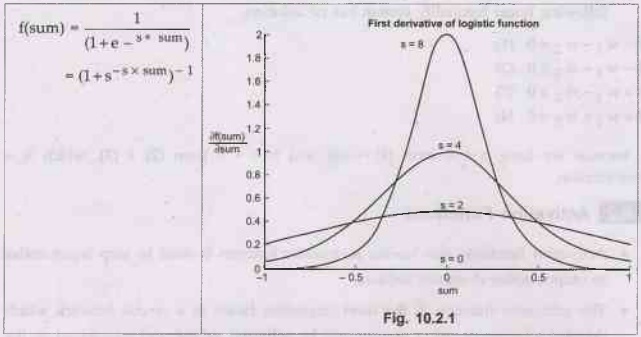
• Logistic function monotonically increases from a lower
limit (0 or 1) to an upper limit (+1) as sum increases. In which values vary
between 0 and 1, with a value of 0.5 when I is zero.
•
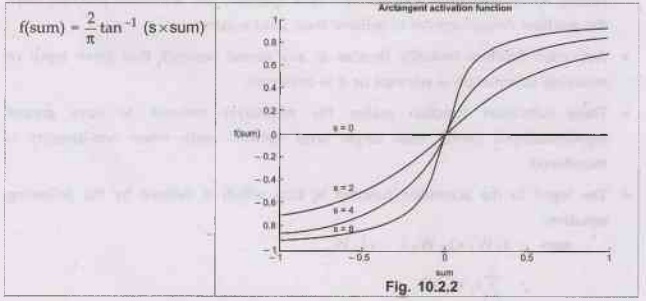
Activation Function: Arc Tangent
•
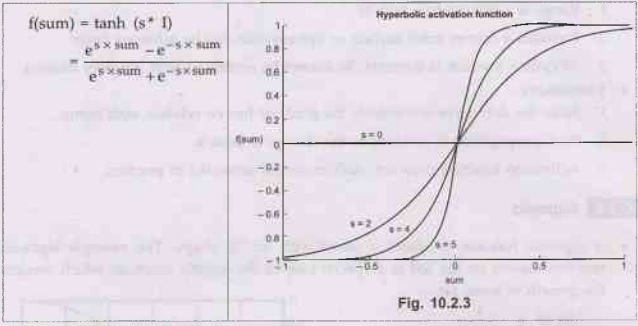
Activation Function: Hyperbolic Tangent
Identity or Linear Activation Function
•
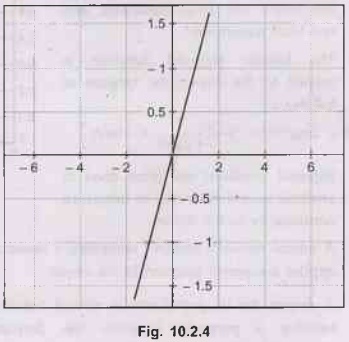
A linear activation is a mathematical equation used
for obtaining output vectors with specific properties.
•
It is a simple straight line activation function
where our function is directly proportional to weighted sum of neurons or
input.
•
Linear activation functions are better in giving a
wide range activations and a line of a positive slops may increase the firing
rate as the input rate increases.
•
Fig. 10.2.4 shows identity function.
•
The equation for linear activation function is :
f(x)
= a.x
When
a = 1 then f(x) = x and this is a special case known as identity.
•
Properties:
1.
Range is - infinity to + infinity
2.
Provides a convex error surface so optimisation can be achieved faster.
3.
df(x)/dx = a which is constant. So cannot be optimised with gradient descent.
•
Limitations:
1.
Since the derivative is constant, the gradient has no relation with input.
2.
Back propagation is constant as the change is delta x.
3.Activation
function does not work in neural networks in practice.
Sigmoid
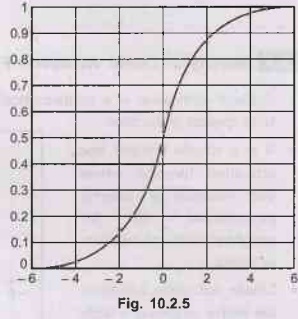
• A sigmoid function produces a curve with an "S" shape. The example sigmoid function shown on the left is a special case of the logistic function, which models the growth of some set.
Sig (t) =1/1+e-t
•
In general, a sigmoid function is real-valued and
differentiable, having a non-negative or non-positive first derivative, one
local minimum, and one local maximum.
•
The logistic sigmoid function is related to the
hyperbolic tangent as follows:
1 -
2 sig (x) = 1- 2.1/1+e–x = -tanh x/2
•
Sigmoid functions are often used in artificial neural
networks to introduce nonlinearity in the model.
•
A neural network element computes a linear
combination of its input signals, and applies a sigmoid function to the result.
•
A reason for its popularity in neural networks is because
the sigmoid function satisfies a property between the derivative and itself
such that it is computationally easy to perform.
d/dt sig (t) = sig(t) (1 - sig (t))
Artificial Intelligence and Machine Learning: Unit V: Neural Networks : Tag: : Neural Networks - Artificial Intelligence and Machine Learning - Activation Functions
Artificial Intelligence and Machine Learning: Unit V: Neural Networks
Under Subject
Artificial Intelligence and Machine Learning
CS3491 4th Semester CSE/ECE Dept | 2021 Regulation | 4th Semester CSE/ECE Dept 2021 Regulation
Artificial Intelligence and Machine Learning
EC25401 4th Semester ECE Department | 2025 Regulation | 4th Semester 2025 Regulation
Related Subjects

Environmental Sciences and Sustainability
GE3451 ESS 4th Semester | 2021 Regulation | 4th Semester EEE Dept 2021 Regulation

Theory of Computation
CS3452 4th Semester CSE Dept | 2021 Regulation | 4th Semester CSE Dept 2021 Regulation
Artificial Intelligence and Machine Learning
CS3491 4th Semester CSE/ECE Dept | 2021 Regulation | 4th Semester CSE/ECE Dept 2021 Regulation

Database Management System
CS3492 4th Semester CSE Dept | 2021 Regulation | 4th Semester CSE Dept 2021 Regulation
Algorithms
CS3401 4th Semester CSE Dept | 2021 Regulation | 4th Semester CSE Dept 2021 Regulation

Introduction to Operating Systems
CS3451 4th Semester CSE Dept | 2021 Regulation | 4th Semester CSE Dept 2021 Regulation