Data Structure: Unit IV : Multiway Search Trees and Graphs
Representation of Graph
with Example C Programs | Data Structure
There various representations of graphs. The most commonly used representations are :1. Adjacency Matrix Representation,2. Adjacency List Representation
Representation
of Graph
There
various representations of graphs. The most commonly used representations are
1.
Adjacency Matrix Representation
2.
Adjacency List Representation
Adjacency Matrix
Consider a graph G of n vertices and the matrix M. If there is an edge present between vertices Vi and Vj then M[i][j] = 1 else M[i][j] = 0. Note that for an undirected graph if M[i][j] =1 then for M[j][i] is also 1. Here are some graphs sh own by adjacency matrix.

Creating a Graph using
Adjacency Matrix
Creation
of graph using adjacency matrix is quite simple task. The adjacency matrix is
nothing but a two dimensional array. The algorithm for creation of graph using
adjacency matix will be as follows:
1)
Declare an array of M[size] [size] which will store the graph.
2) Enter
how many nodes you want in a graph.
3) Enter
the edges of the graph by two vertices each, say Vi, Vj
indicates some edge.
4) If the graph is directed set M[i][j]=1. If graph is undirected set M[i][j] = 1 and M[j][i]= 1 as well.
5) When
all the edges for the desired graph is entered print the graph M[i][j].
Adjacency List
The type of representation of a graph in which the linked list is used, is called Adjacency
List representation.
There
are two methods of representing the adjacency list.
Method 1:
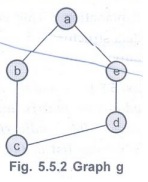
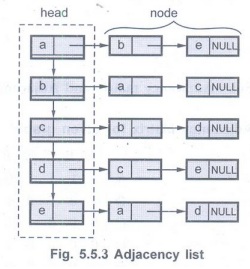
For graph G in Fig. 5.5.2, the nodes as a, b, c, d, e. So we will maintain the linked list of these head nodes as well as the adjacent nodes. The 'C' structure will be
typedef
struct head
}
char
data;
struct
head *down;
struct
head *next;
}
typedef
struct node
{
int ver;
struct
node *link;
}
Explanation: This is purely the
adjacency list graph. The down pointer helps us to go to each node in the graph
whereas the next node is for going to adjacent node of each of the head node.
Method
2: In this method of representing the adjacency list, we take mixed data
structure. That means instead of taking the head list as a linked list we will
take an array of head nodes. So only one 'C' structure will be there
representing the adjacent nodes. See the
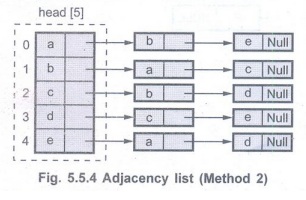
Fig. 5.5.4 representing the adjacency list for the above graph. First let us see the 'C' structure.
typedef
struct node1
{
char
vertex;
struct
node1 *next
}node
node *
head [5]
Explanation: This is the graph which can
be represented with the array and linked list data structures. Array is used to
store the head nodes. The node strucutre will be the same through out.
Ex. 5.5.1 What do you mean adjacency matrix and
adjacency list ? Give the adjacency matrix and adjacency list of the following
graph:
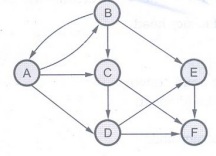
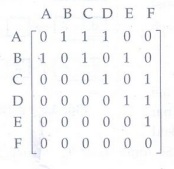
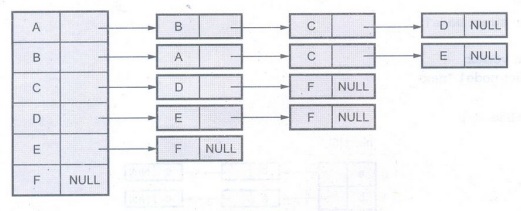
Sol. Adjacency matrix and Adjacency list
Adjacency Matrix for given graph
Adjacency
List for given graph
Ex. 5.5.2 Represent following graph using adjacency matrix and adjacency list.

Ex. 5.5.3 Draw the adjacency list of the graph
given in Fig. 5.5.6.

Ex.
5.5.4 Write an algorithm to find indegree and outdegree of a vertex in a given
graph.
Sol
1.
Initialize indegree and outdegree count for each node to zero.
2. Visit
each node of a graph.
3. Count
the number of incoming edges of each node and then increment indegree count by
one for each incoming each.
4. Count
the number of outgoing edges of each node and then increment outdegree count by
one on each outgoing edge.
Ex. 5.5.5 Write a function to print indegree,
outdegree and total degree of given vertex. Sol. :
void
print_degree()
{
int v;
for(v=0;v<n;v++)
{
in=indegree(v,n);
out
outdegree(v,int n);
total=in+out;
printf("\n
The indegree for vertex %d is %d",v,in); game jar
printf("\n
The outdegree for vertex %d is %d",v,out);
printf("\n
The total degree for vertex %d is %d",v,total);
}
int
indegree(int v,n)
{
int
v1,count=0;
for(v1=0;v1<n;v1++)
if(a[v1][v]
==1)
count++;
return
count;
}
int
outdegree(int v,int n)
{
int
v2,count=0;
for(v2=0;v2<n;v2++)
if(a[v][v2]==1).
.count++;
return
count;
}
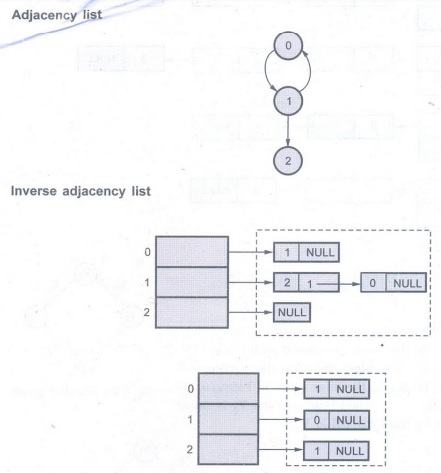
Ex. 5.5.6 Explain with example inverse adjacency list representation of graph. Consider following graph.
Ex. 5.5.7 Give the adjacency matrix and
adjacency
list representation for the graph shown in following Fig. 5.5.7.

Data Structure: Unit IV : Multiway Search Trees and Graphs : Tag: : with Example C Programs | Data Structure - Representation of Graph
Data Structure: Unit IV : Multiway Search Trees and Graphs
Under Subject
Data Structure
CS3301 3rd Semester CSE Dept | 2021 Regulation | 3rd Semester CSE Dept 2021 Regulation
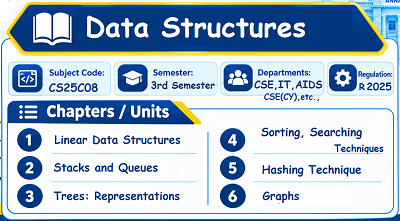
Data Structures
CS25C08 3rd Semester CSE,IT,CY,AIDS departments. | 2025 Regulation | 3rd Semester 2025 Regulation
Related Subjects
Discrete Mathematics
MA3354 3rd Semester CSE Dept | 2021 Regulation | 3rd Semester CSE Dept 2021 Regulation

Digital Principles and Computer Organization
CS3351 3rd Semester CSE Dept | 2021 Regulation | 3rd Semester CSE Dept 2021 Regulation
Foundation of Data Science
CS3352 3rd Semester CSE Dept | 2021 Regulation | 3rd Semester CSE Dept 2021 Regulation
Data Structure
CS3301 3rd Semester CSE Dept | 2021 Regulation | 3rd Semester CSE Dept 2021 Regulation

Object Oriented Programming
CS3391 3rd Semester CSE Dept | 2021 Regulation | 3rd Semester CSE Dept 2021 Regulation