Basic Electrical and Electronics Engineering: Unit II: Electrical Machines
Principle of Operation of 3ϕ Induction Motor
with Solved Example Problems
Three phase supply is given to the stator windings. Due to this, current flows through the stator winding.
PRINCIPLE
OF OPERATION OF 3Φ INDUCTION MOTOR
Three
phase supply is given to the stator windings. Due to this, current flows
through the stator winding. This current is called stator current. It produces
a rotating magnetic field in the space between stator and rotor. Synchronous
speed is produced by this field.
Ns
= 120ƒ/P
The
rotating magnetic field cutting the rotor conductors, an emf is induced in the
rotor. If the rotor winding is shorted then the induced emf produces current.
this current produces a rotor field.
The
interaction of stator and rotor field develops torque. Then the rotor rotates
in the same direction as the rotating magnetic field. When the rotor is
standstill, the frequency rotor emf is equal to the supply frequency.
As
the rotor speed increases, the frequency of rotor emf and the magnitude of
rotor emf decreases.
The
rotor tries to each up with the rotating magnetic field. But the rotor could
not rotate at the synchronous speed. Therefore, the rotor runs at a speed
slightly less than the synchronous speed.
The
difference between synchronous speed and rotor speed is called the slip speed.
Slip
speed = NS - N
Slip
(S) = NS – N/ NS
N
= NS (1-S)
%
Slip = NS – N/NS × 100
At
no load the difference between synchronous speed and rotor is only about 1%
Squirrel
cage induction motor
Advantages
Cheaper,
light weight, higer efficiency, less maintenance
Disadvantages
Moderate
starting torque, there is no external resistance in the rotor circuit, so the
starting torque cannot be controlled.
Applications
Lathes,
drilling machines, fans, blowers, water pumps, grinders, printing machines etc
Slip
ring induction motor
Advantages
Starting
torque can be controlled by varying the rotor circuit resistance, speed is also
controlled
Disadvantages
Heavier
in size, high cost, high rotor inertia, high speed lamination, maintenance and
reliability problems due to brushes and slip rings.
Applications
Lifts,
hosts, cranes, elevators, compressors etc
Example: 21
A 6 pole 3ϕ, induction motor is
connected to 50 Hz supply. If it is running at 960 rpm, find the slip.
P
= 6, f = 50 Hz, N = 960 rpm
NS
= 120ƒ/P = 120 × 50/6 = 1000 rpm
Slip,
S = NS – N/ NS × 100
=1000–960/1000 × 100
=
0.04 (or) 4%
Example: 22
A 2 pole, 3ϕ, 50 Hz induction motor is running on no load with a slip of 4% calculate (i) the synchronous speed (ii) speed of the motor.
P
= 2, f = 50 Hz, S = 4% (or) 0.04
(i) Synchronous speed
NS
= 120ƒ/P = 120 × 50/2 = 3000 rpm
(ii)
Speed of the motor
N
= NS (1-S)
=
3000 (1 - 0.04)
N
= 2880 rpm
Frequency
of rotor current or emf
When
the rotor is stationary, the relative speed between the rotor winding and the
rotating magnetic field is NS. Hence the frequency of emf induced
and the resultant current is PNS /120 that is same as the supply
frequency (ƒ). As the rotor speed increases, the relative speed is (NS
- N) and the rotor frequency is

Slip
S = NS – N / NS
SNS
= NS - N = S(120ƒ/P)

ƒr
= Sƒ
Example: 23
A 4 pole, 3ƒ induction motor
operates from a supply whose frequency is 50 Hz. Calculate.
i) The whose speed at which the
magnetic field of the stator is rotating
ii) The speed of the rotor when the
slip is 0.04
iii) The frequency of the rotor
currents when the slip is 0.03
iv) The frequency of the rotor
currents at stand still.
P
= 4, ƒ = 50 Hz
(i) Speed
of the stator
NS
= 120ƒ/P = 120×50 / 4 = 1500 rpm
(ii) Rotor
speed at slip 0.04
N
= NS (1-S)
=
1500 (1 - 0.04)
=
1440 rpm
(iii)
Frequency of rotor current at slip = 0.03
ƒr
= Sƒ
=
0.03 × 50
=
1.5
(iv)
Frequency at standstill
S
= 1
ƒr
= Sƒ = 1 × 50
Basic Electrical and Electronics Engineering: Unit II: Electrical Machines : Tag: : with Solved Example Problems - Principle of Operation of 3ϕ Induction Motor
Basic Electrical and Electronics Engineering: Unit II: Electrical Machines
Under Subject
Basic Electrical and Electronics Engineering
BE3251 2nd semester Mechanical Dept | 2021 Regulation | 2nd Semester Mechanical Dept 2021 Regulation
Basic Electrical and Electronics Engineering
BE3251 2nd Semester CSE Dept 2021 | Regulation | 2nd Semester CSE Dept 2021 Regulation
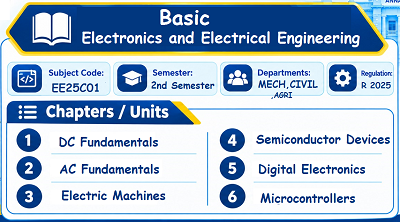
Basic Electrical and Electronics Engineering
EE25C01 2nd Semester | 2025 Regulation | 2nd Semester 2025 Regulation
Related Subjects
Professional English II
HS3251 2nd Semester 2021 Regulation | 2nd Semester Common to all Dept 2021 Regulation
Statistics and Numerical Methods
MA3251 2nd Semester 2021 Regulation M2 Engineering Mathematics 2 | 2nd Semester Common to all Dept 2021 Regulation
Engineering Graphics
GE3251 eg 2nd semester | 2021 Regulation | 2nd Semester Common to all Dept 2021 Regulation
Physics for Electrical Engineering
PH3202 2nd Semester 2021 Regulation | 2nd Semester EEE Dept 2021 Regulation
Basic Civil and Mechanical Engineering
BE3255 2nd Semester 2021 Regulation | 2nd Semester EEE Dept 2021 Regulation
Electric Circuit Analysis
EE3251 2nd Semester 2021 Regulation | 2nd Semester EEE Dept 2021 Regulation
Physics for Electronics Engineering
PH3254 - Physics II - 2nd Semester - ECE Department - 2021 Regulation | 2nd Semester ECE Dept 2021 Regulation
Electrical and Instrumentation Engineering
BE3254 - 2nd Semester - ECE Dept - 2021 Regulation | 2nd Semester ECE Dept 2021 Regulation
Circuit Analysis
EC3251 - 2nd Semester - ECE Dept - 2021 Regulation | 2nd Semester ECE Dept 2021 Regulation
Materials Science
PH3251 2nd semester Mechanical Dept | 2021 Regulation | 2nd Semester Mechanical Dept 2021 Regulation
Basic Electrical and Electronics Engineering
BE3251 2nd semester Mechanical Dept | 2021 Regulation | 2nd Semester Mechanical Dept 2021 Regulation
Physics for Civil Engineering
PH3201 2021 Regulation | 2nd Semester Civil Dept 2021 Regulation
Basic Electrical, Electronics and Instrumentation Engineering
BE3252 2021 Regulation | 2nd Semester Civil Dept 2021 Regulation
Physics for Information Science
PH3256 2nd Semester CSE Dept | 2021 Regulation | 2nd Semester CSE Dept 2021 Regulation
Basic Electrical and Electronics Engineering
BE3251 2nd Semester CSE Dept 2021 | Regulation | 2nd Semester CSE Dept 2021 Regulation
Programming in C
CS3251 2nd Semester CSE Dept 2021 | Regulation | 2nd Semester CSE Dept 2021 Regulation