Basic Electrical and Electronics Engineering: Unit II: Electrical Machines
Principle of operation for Synchronous Motor
When a sinusoidal (single-phase) voltage is applied to a winding, the magnetic field produced by the resultant current flow will also be sinusoidally varying with respect to time.
PRINCIPLE
OF OPERATION FOR SYNCHRONOUS MOTOR
When
a sinusoidal (single-phase) voltage is applied to a winding, the magnetic field
produced by the resultant current flow will also be sinusoidally varying with
respect to time. This means that the field is pulsating. Now when a three-phase
voltage is applied to a three-phase winding, the flux is produced will be
resultant of all the three pulsating fields. It can be shown that the resultant
field has a magnitude of 1.5ϕm where ϕm is the maximum
value of the flux due to a single phase current. Further it can also be shown
that the direction of the field changes continuously, i.e., the field is
rotating in space at a speed given by,
NS
= 120 × ƒ/ P
Where,
ƒ is the frequency of supply and P is the number of poles. This speed is called
the synchronous speed.

Hence
it is to be remembered that when a three-phase supply is given to a three-
phase winding a magnetic field of constant magnitude but rotating at a constant
speed, NS is produced.
Figure
3.58 shows that the two fictitious stator poles marked NS and SS
assumed to rotate clockwise at a synchronous speed NS. The rotor
poles (assumed to be only 2 in number), NR and SR are
formed by the d.c excitation. When NS and NR together
(and similarly SS and SR) like poles repel each other.
Since NS and SS are moving in the clock direction, NR
and SR tend to figure. Half a cycle later, the stator poles have
moved, whereas the rotor poles have moved significantly. This situation is
shown in figure NS and and similarly SS and NR
get attracted and the rotor tries to rotate in the clockwise direction. This
implies that the rotor experiences torque in different directions every half a cycle.
As a result, the rotor is at standstill due to its large inertia. This explains
why a synchronous motor has no starting torque and cannot start by itself.
However,
if the rotor is now rotated separately by a prime mover in the same direction
as the synchronously rotating stator field, and at a speed near NS,
then it is possible that at some instant of time NS and SR
and similarly SS and NR (ie., The stator and rotor poles)
get attracted and locked to one another. This is shown in figure 3.59.

Hence
a synchronous motor, though not self starting, starts working as a motor if it is
started up by some means.
It
needs two separate supplies-one a d.c source for excitation of the rotor and
other, a three-phase supply for the stator. Because of the interlocking between
the stator and rotor poles, the motor runs only at one speed, the synchronous
speed.
Basic Electrical and Electronics Engineering: Unit II: Electrical Machines : Tag: : - Principle of operation for Synchronous Motor
Basic Electrical and Electronics Engineering: Unit II: Electrical Machines
Under Subject

Basic Electrical and Electronics Engineering
BE3251 2nd semester Mechanical Dept | 2021 Regulation | 2nd Semester Mechanical Dept 2021 Regulation

Basic Electrical and Electronics Engineering
BE3251 2nd Semester CSE Dept 2021 | Regulation | 2nd Semester CSE Dept 2021 Regulation
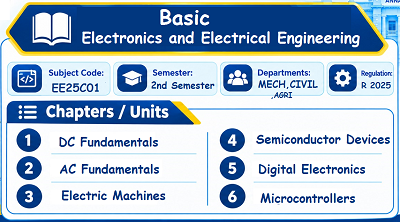
Basic Electrical and Electronics Engineering
EE25C01 2nd Semester | 2025 Regulation | 2nd Semester 2025 Regulation
Related Subjects

Professional English II
HS3251 2nd Semester 2021 Regulation | 2nd Semester Common to all Dept 2021 Regulation
Statistics and Numerical Methods
MA3251 2nd Semester 2021 Regulation M2 Engineering Mathematics 2 | 2nd Semester Common to all Dept 2021 Regulation

Engineering Graphics
GE3251 eg 2nd semester | 2021 Regulation | 2nd Semester Common to all Dept 2021 Regulation

Physics for Electrical Engineering
PH3202 2nd Semester 2021 Regulation | 2nd Semester EEE Dept 2021 Regulation
Basic Civil and Mechanical Engineering
BE3255 2nd Semester 2021 Regulation | 2nd Semester EEE Dept 2021 Regulation
Electric Circuit Analysis
EE3251 2nd Semester 2021 Regulation | 2nd Semester EEE Dept 2021 Regulation
Physics for Electronics Engineering
PH3254 - Physics II - 2nd Semester - ECE Department - 2021 Regulation | 2nd Semester ECE Dept 2021 Regulation
Electrical and Instrumentation Engineering
BE3254 - 2nd Semester - ECE Dept - 2021 Regulation | 2nd Semester ECE Dept 2021 Regulation
Circuit Analysis
EC3251 - 2nd Semester - ECE Dept - 2021 Regulation | 2nd Semester ECE Dept 2021 Regulation

Materials Science
PH3251 2nd semester Mechanical Dept | 2021 Regulation | 2nd Semester Mechanical Dept 2021 Regulation
Basic Electrical and Electronics Engineering
BE3251 2nd semester Mechanical Dept | 2021 Regulation | 2nd Semester Mechanical Dept 2021 Regulation

Physics for Civil Engineering
PH3201 2021 Regulation | 2nd Semester Civil Dept 2021 Regulation
Basic Electrical, Electronics and Instrumentation Engineering
BE3252 2021 Regulation | 2nd Semester Civil Dept 2021 Regulation

Physics for Information Science
PH3256 2nd Semester CSE Dept | 2021 Regulation | 2nd Semester CSE Dept 2021 Regulation
Basic Electrical and Electronics Engineering
BE3251 2nd Semester CSE Dept 2021 | Regulation | 2nd Semester CSE Dept 2021 Regulation
Programming in C
CS3251 2nd Semester CSE Dept 2021 | Regulation | 2nd Semester CSE Dept 2021 Regulation