Programming in C: Unit I (b): Introduction to C
Basic Data Types in C
C Program
C language provides very few basic data types.lists the basic data types, their size, range, and usage for a C programmer on a 16-bit computer.
BASIC
DATA TYPES IN C
C
language provides very few basic data types. Table 2.3 lists the basic data
types, their size, range, and usage for a C programmer on a 16-bit computer. In
addition to this, we also have variants of int
and float data types.
The
char data type is of one byte and is
used to store single characters. Note that C does not provide any data type for
storing text. This is because text is made up of xt is individual characters.
You
will be surprised to see that the range of char is given as -128 to 127. char is supposed to store characters not
numbers, so why this range? The answer is that, in memory characters are stored
in their ASCII codes. For example, the character A has the ASCII code 65. In
memory we will not store 'A' but 65 (in binary number format).

In
addition, C also supports four modifiers-two sign specifiers (signed and
unsigned) and two size specifiers (short
and long).
Table
2.4 shows the variants of basic data types.
In
Table 2.4, we have unsigned char and signed char. Do we have negative
characters? No, then why do we have such data types? The answer is that we use signed and unsigned char to ensure portability of programs that store
non-character data as char.

While
the smaller data types take less memory, the larger types incur a performance
penalty. Although the data type we use for our variables does not have a big
impact on the speed or memory usage of the application, we should always try to
use int unless there is a special need
to use any other data type.
Last
but not the least the void type holds
no value. It is primarily used in three cases:
•
To specify the return type of a function (when the function returns no value)
•
To specify the parameters of the function (when the function accepts no
arguments from the caller).
•
To create generic pointers. We will read about generic pointers in the chapter
on Pointers.
We
will discuss the void data type in
detail in the coming chapters.
Note
Unsigned
int/char keeps the sign bit free and makes the entire word available for
storage of the non-negative numbers.
Sign
bit is the leftmost bit of a memory word which is used to determine the sign of
the content stored in that word. When it is 0, the value is positive and when
it is 1, the value is negative.
How are Float and Double Stored?
In
computer memory, float and double values are stored in mantissa and exponent
forms where the exponent represents power of 2 (not 10). The number of bytes
used to represent a floating point number generally depends on the precision of
the value. While float is used to declare single-precision values, double is
used to represent double- precision values.
Floating-point
numbers use the IEEE (Institute of Electrical and Electronics Engineers) format
to represent mantissa and exponents. According to the IEEE format, a floating
point value in its binary form is known as a normalized form. In the normalized form, the exponent is adjusted
in such a way that the binary point in the mantissa always lies to the right of
the most significant non-zero digit.
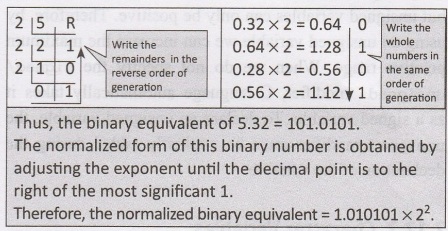
Example 2.1
Convert
the floating point number 5.32 into an IEEE normalized form.
Moreover,
the IEEE format for storing floating point numbers uses a sign bit, mantissa,
and the exponent (Figure 2.9). The sign bit denotes the sign of the value. If
the value is positive, the sign bit contains 0 and in case the value is
negative it stores 1.
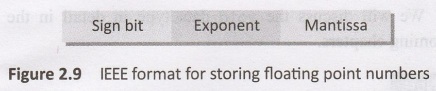
Generally, exponent
is an integer value stored in unsigned binary format after adding a positive
bias. In other words, because exponents are stored in an unsigned form, the
exponent is biased by half its possible value. For type float, the bias is 127; for type double, it is 1023. You can compute the actual exponent value
by subtracting the bias value from the exponent value. Finally, the normalized
binary equivalent is stored in such a way that lower byte is stored at higher
memory address. For example, ABCD is actually stored as DCBA.
Programming in C: Unit I (b): Introduction to C : Tag: : C Program - Basic Data Types in C
Programming in C: Unit I (b): Introduction to C
Under Subject
Programming in C
CS3251 2nd Semester CSE Dept 2021 | Regulation | 2nd Semester CSE Dept 2021 Regulation
Related Subjects
Professional English II
HS3251 2nd Semester 2021 Regulation | 2nd Semester Common to all Dept 2021 Regulation
Statistics and Numerical Methods
MA3251 2nd Semester 2021 Regulation M2 Engineering Mathematics 2 | 2nd Semester Common to all Dept 2021 Regulation

Engineering Graphics
GE3251 eg 2nd semester | 2021 Regulation | 2nd Semester Common to all Dept 2021 Regulation

Physics for Electrical Engineering
PH3202 2nd Semester 2021 Regulation | 2nd Semester EEE Dept 2021 Regulation

Basic Civil and Mechanical Engineering
BE3255 2nd Semester 2021 Regulation | 2nd Semester EEE Dept 2021 Regulation
Electric Circuit Analysis
EE3251 2nd Semester 2021 Regulation | 2nd Semester EEE Dept 2021 Regulation

Physics for Electronics Engineering
PH3254 - Physics II - 2nd Semester - ECE Department - 2021 Regulation | 2nd Semester ECE Dept 2021 Regulation

Electrical and Instrumentation Engineering
BE3254 - 2nd Semester - ECE Dept - 2021 Regulation | 2nd Semester ECE Dept 2021 Regulation
Circuit Analysis
EC3251 - 2nd Semester - ECE Dept - 2021 Regulation | 2nd Semester ECE Dept 2021 Regulation

Materials Science
PH3251 2nd semester Mechanical Dept | 2021 Regulation | 2nd Semester Mechanical Dept 2021 Regulation

Basic Electrical and Electronics Engineering
BE3251 2nd semester Mechanical Dept | 2021 Regulation | 2nd Semester Mechanical Dept 2021 Regulation

Physics for Civil Engineering
PH3201 2021 Regulation | 2nd Semester Civil Dept 2021 Regulation

Basic Electrical, Electronics and Instrumentation Engineering
BE3252 2021 Regulation | 2nd Semester Civil Dept 2021 Regulation

Physics for Information Science
PH3256 2nd Semester CSE Dept | 2021 Regulation | 2nd Semester CSE Dept 2021 Regulation

Basic Electrical and Electronics Engineering
BE3251 2nd Semester CSE Dept 2021 | Regulation | 2nd Semester CSE Dept 2021 Regulation
Programming in C
CS3251 2nd Semester CSE Dept 2021 | Regulation | 2nd Semester CSE Dept 2021 Regulation