Programming in C: Unit III (b): Pointers
Arrays of Pointers
with Example C Programs
An array of pointers can be declared as int *ptr [10];The above statement declares an array of 10 pointers where each of the pointer points to an integer variable.
ARRAYS
OF POINTERS
An
array of pointers can be declared as
int *ptr [10];
The
above statement declares an array of 10 pointers where each of the pointer
points to an integer variable. For example, look at the code given below.
int *ptr [10];
int p = 1, q = 2, r = 3, s = 4, t =
5;
ptr[0] = &p;
ptr[1] = &q;
ptr [2] = &r;
ptr [3] = &s;
ptr [4] = &t
Can
you tell what will be the output of the following statement?
printf("\n %d", *ptr
[3]);
The
output will be 4 because ptr [3]
stores the address of integer variable and *ptr
[3] will therefore print the value of s that i value t is 4. Now look at ok
at another code in which we store the address of three individual arrays in the
array of pointers.
main()
{
int arr1 []={1,2,3,4,5);
int arr2 []=(0,2,4,6,8};
int arr3 []={1,3,5,7,9};
int *parr [3] = (arr1, arr2, arr3);
int i;
for (i = 0;i<3;i++)
printf("%d", *parr[i]);
}
Output
1 0 1
Surprised
with this output? Try to understand the concept. In the for loop, parr [0] stores
the base address of arr1 (or, &arr1 [0]). So writing *parr [0] will print the value stored at
&arr1 [0]. Same is the case with *parr [1] and *parr [2].
Now
consider an array of character pointers that points to strings.
char *ptr [3];
In
the ptr array, each element is a
character pointer. Therefore, we can assign character pointers to the elements
of the array. For example,
ptr[0]
= str;
Another
way to initialize an array of characters with three strings can be given as,
char *ptr[3] = {"Janak",
"Raj", "Paul"};
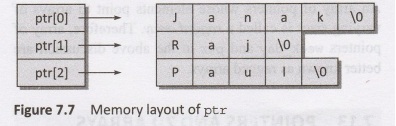
Here, ptr [0] is Janak, ptr[1] is Raj, and ptr [2]
is Paul.
The
memory layout of ptr can be given as
shown in Figure 7.7. It requires only 15 bytes to store the three strings.
However,
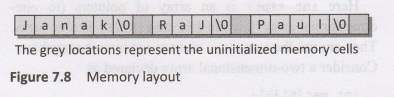
char str[3] [10] = {"Janak", "Raj", "Paul"}; will
behave in the same way as an array of characters. The only difference is the
memory layout (Figure 7.8). While the array of pointers needs only 15 bytes of
storage, str will reserve 30 bytes in
memory, despite the fact that some memory locations will be reserved but not
utilized.
Look
at the following program that uses an array of character pointer to display the
name of the day corresponding to the number.
#include <stdio.h>
char *day_of_week (int);
main()
{
int day_num;
char *day;
printf("\n Enter the day from
1 to 7: ");
scanf("%d",
&day_num);
day = day_of_week (day_num);
if (day)
printf("%s", day);
else
printf("\n Invalid Day");
}
char *day_of_week (int day)
{
char *week_day [7] =
{"SUNDAY", "MONDAY", "TUESDAY",
"WEDNESDAY", "THURSDAY", "FRIDAY",
"SATURDAY"};
if (day>=1 | | day<=7)
return week_day [day-1];
else
return NULL;
}
Output
Enter the day from 1 to 7: 3
TUESDAY
An
array of pointers whose elements point to arrays of varying sizes is called a ragged array. Therefore, array of
pointers week_day and ptr in the above discussion are better
known as ragged arrays.
Programming in C: Unit III (b): Pointers : Tag: : with Example C Programs - Arrays of Pointers
Programming in C: Unit III (b): Pointers
Under Subject
Programming in C
CS3251 2nd Semester CSE Dept 2021 | Regulation | 2nd Semester CSE Dept 2021 Regulation
Related Subjects
Professional English II
HS3251 2nd Semester 2021 Regulation | 2nd Semester Common to all Dept 2021 Regulation
Statistics and Numerical Methods
MA3251 2nd Semester 2021 Regulation M2 Engineering Mathematics 2 | 2nd Semester Common to all Dept 2021 Regulation

Engineering Graphics
GE3251 eg 2nd semester | 2021 Regulation | 2nd Semester Common to all Dept 2021 Regulation

Physics for Electrical Engineering
PH3202 2nd Semester 2021 Regulation | 2nd Semester EEE Dept 2021 Regulation

Basic Civil and Mechanical Engineering
BE3255 2nd Semester 2021 Regulation | 2nd Semester EEE Dept 2021 Regulation
Electric Circuit Analysis
EE3251 2nd Semester 2021 Regulation | 2nd Semester EEE Dept 2021 Regulation

Physics for Electronics Engineering
PH3254 - Physics II - 2nd Semester - ECE Department - 2021 Regulation | 2nd Semester ECE Dept 2021 Regulation

Electrical and Instrumentation Engineering
BE3254 - 2nd Semester - ECE Dept - 2021 Regulation | 2nd Semester ECE Dept 2021 Regulation
Circuit Analysis
EC3251 - 2nd Semester - ECE Dept - 2021 Regulation | 2nd Semester ECE Dept 2021 Regulation

Materials Science
PH3251 2nd semester Mechanical Dept | 2021 Regulation | 2nd Semester Mechanical Dept 2021 Regulation

Basic Electrical and Electronics Engineering
BE3251 2nd semester Mechanical Dept | 2021 Regulation | 2nd Semester Mechanical Dept 2021 Regulation

Physics for Civil Engineering
PH3201 2021 Regulation | 2nd Semester Civil Dept 2021 Regulation

Basic Electrical, Electronics and Instrumentation Engineering
BE3252 2021 Regulation | 2nd Semester Civil Dept 2021 Regulation

Physics for Information Science
PH3256 2nd Semester CSE Dept | 2021 Regulation | 2nd Semester CSE Dept 2021 Regulation

Basic Electrical and Electronics Engineering
BE3251 2nd Semester CSE Dept 2021 | Regulation | 2nd Semester CSE Dept 2021 Regulation
Programming in C
CS3251 2nd Semester CSE Dept 2021 | Regulation | 2nd Semester CSE Dept 2021 Regulation