Basic Electrical and Electronics Engineering: Unit III: Analog Electronics
Three Phase Inverter
Circuit and Waveform diagram, Operation
A three-phase inverter converts a DC input into a three-phase AC output. Its three arms are normally delayed by an angle of 120° so as to generate a three-phase AC supply.
THREE
PHASE INVERTER
A
three-phase inverter converts a DC input into a three-phase AC output. Its
three arms are normally delayed by an angle of 120° so as to generate a
three-phase AC supply. The inverter switches each has a ratio of 50% and
switching occurs after every T/6 of the time T 60°angleinterval. The switches S1
and S4, the switches S2 and S5 and switches S3 and S6 complement each other.
The
figure shows a circuit for a three phase inverter. It is nothing but three
single phase inverters put across the same DC source. The pole voltages in a
three phase inverter are equal to the pole voltages in single phase half bridge
inverter.

Inverters
have two modes of conduction -
1.
180° mode of conduction and
2.
120° mode of conduction.
180°
mode of conduction
In
this mode of conduction, every device is in conduction state for 180° where
they are switched ON at 60° intervals. The terminals A, B and C are the output
terminals of the bridge that are connected to the three-phase delta or star
connection of the load.
The
operation of a balanced star connected load is explained in the diagram below.
For the period 0°-60° the points S1, S5 and S6 are in conduction mode. The
terminals A and C of the load are connected to the source at its positive
point. The terminal B is connected to the source at its negative point. In
addition, resistances R/2 is between the neutral and the positive end while
resistance R is between the neutral and the negative terminal.
The
load voltages are gives as follows;
VAN
= V/3,
VBN
= -2V/3,
VCN
= V/3
The
line voltages are given as follows;
VAB
= VAN - VBN = V,
VBC
= VBN - VCN = -V,
VCA
= VCN - VAN = 0
Waveforms
for 180° mode of conduction

120°
mode of conduction
In
this mode of conduction, each electronic device is in a conduction state for
120°. It is most suitable for a delta connection in a load because it results
in a six- step type of waveform across any of its phases. Therefore, at any
instant only two devices are conducting because each device conducts at only
120°.
The
terminal A on the load is connected to the positive end while the terminal B is
connected to the negative end of the source. The terminal C on the load is in a
condition called floating state. Furthermore, the phase voltages are equal to
the load voltages as shown below.
Phase
voltages = Line voltages
VAB
= V
VBC
= -V/2
VCA
= -V/2
Waveforms
for 120° mode of conduction

Basic Electrical and Electronics Engineering: Unit III: Analog Electronics : Tag: : Circuit and Waveform diagram, Operation - Three Phase Inverter
Basic Electrical and Electronics Engineering: Unit III: Analog Electronics
Under Subject
Basic Electrical and Electronics Engineering
BE3251 2nd semester Mechanical Dept | 2021 Regulation | 2nd Semester Mechanical Dept 2021 Regulation
Basic Electrical and Electronics Engineering
BE3251 2nd Semester CSE Dept 2021 | Regulation | 2nd Semester CSE Dept 2021 Regulation
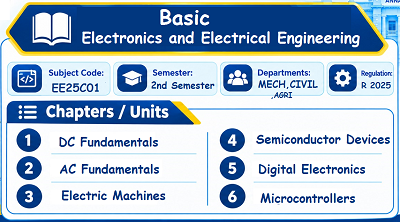
Basic Electrical and Electronics Engineering
EE25C01 2nd Semester | 2025 Regulation | 2nd Semester 2025 Regulation
Related Subjects
Professional English II
HS3251 2nd Semester 2021 Regulation | 2nd Semester Common to all Dept 2021 Regulation
Statistics and Numerical Methods
MA3251 2nd Semester 2021 Regulation M2 Engineering Mathematics 2 | 2nd Semester Common to all Dept 2021 Regulation
Engineering Graphics
GE3251 eg 2nd semester | 2021 Regulation | 2nd Semester Common to all Dept 2021 Regulation
Physics for Electrical Engineering
PH3202 2nd Semester 2021 Regulation | 2nd Semester EEE Dept 2021 Regulation
Basic Civil and Mechanical Engineering
BE3255 2nd Semester 2021 Regulation | 2nd Semester EEE Dept 2021 Regulation
Electric Circuit Analysis
EE3251 2nd Semester 2021 Regulation | 2nd Semester EEE Dept 2021 Regulation
Physics for Electronics Engineering
PH3254 - Physics II - 2nd Semester - ECE Department - 2021 Regulation | 2nd Semester ECE Dept 2021 Regulation
Electrical and Instrumentation Engineering
BE3254 - 2nd Semester - ECE Dept - 2021 Regulation | 2nd Semester ECE Dept 2021 Regulation
Circuit Analysis
EC3251 - 2nd Semester - ECE Dept - 2021 Regulation | 2nd Semester ECE Dept 2021 Regulation
Materials Science
PH3251 2nd semester Mechanical Dept | 2021 Regulation | 2nd Semester Mechanical Dept 2021 Regulation
Basic Electrical and Electronics Engineering
BE3251 2nd semester Mechanical Dept | 2021 Regulation | 2nd Semester Mechanical Dept 2021 Regulation
Physics for Civil Engineering
PH3201 2021 Regulation | 2nd Semester Civil Dept 2021 Regulation
Basic Electrical, Electronics and Instrumentation Engineering
BE3252 2021 Regulation | 2nd Semester Civil Dept 2021 Regulation
Physics for Information Science
PH3256 2nd Semester CSE Dept | 2021 Regulation | 2nd Semester CSE Dept 2021 Regulation
Basic Electrical and Electronics Engineering
BE3251 2nd Semester CSE Dept 2021 | Regulation | 2nd Semester CSE Dept 2021 Regulation
Programming in C
CS3251 2nd Semester CSE Dept 2021 | Regulation | 2nd Semester CSE Dept 2021 Regulation