Basic Electrical and Electronics Engineering: Unit III: Analog Electronics
Parallel inverter
Circuit and Waveform diagram, Operation, Advantages, Disadvantages
Parallel Inverters are those Inverters in which commutating components are connected parallel with the load.
PARALLEL
INVERTER
Parallel
Inverters are those Inverters in which commutating components are connected
parallel with the load. Circuit Detail: Parallel inverter circuit is shown in
the figure A, which is consists of two SCRs T1 and T2, an inductor L, an output
transformer and a commutating capacitor C. The function of L is to make the
source current constant. During the working of this inverter, capacitor C comes
in parallel with the load via the transformer. So it is called a parallel
inverter. The turns ratio of half primary winding and secondary winding is kept
unity.

Mode 1
I.
When the SCR T1 is triggered, it will turned on and the current flows through
the path as shown in figure 'B' of the above circuit Vdc (+)-L-c-a-SCR T1 -
Vdc(-).
II.
This will generate flux and resulting EMF in the Transformer Primary Winding ac
and bc.
III.
Due to this induced EMF., the capacitor will charge up to + 2Vdc voltage.
IV.
As there is equal turns ratio between half primary and secondary winding, the
same 2Vdc EMF will be induced in the secondary of transformer secondary and
this EMF will result flow of current through load.
Mode 2
I.
When the SCR T2 is triggered, it will be turned ON and the SCR T1 will be
turned OFF due to capacitor reverse voltage 2Vdc applied across it.
II.
As the SCR T2 is turned ON, the load current flows through path 'C' of the
above circuit Vdc(+)- L-c-b- SCR T2 - Vdc(-) and capacitor will be discharged
through SCR T2.

III. This will generate flux and resulting EMF. in the transformer primary winding bc and ac.
IV.
The capacitor will again charged with opposite polarity upto (-2Vdc)
V.
During this interval of time, the current will flow in reverse direction as
that of when SCR T1 was turned ON.
VI.
Similarly, again the SCR T1 will be turned ON when it triggered and SCR T2 will
be in OFF condition during this interval and this process repeated again and
again.
VII.
Due to alternately switching of SCR T1 and SCR T2, the output voltage become rectangular.
Advantages of Parallel Inverter:
I.
It is Simple forced commutation circuit.
II.
It can give Sinusoidal waveform at output by using suitable filter circuit.
Disadvantages
of Parallel Inverter:
I.
The parallel inverter is useful only when load is fixed.
II.
The parallel inverter does not useful for higher power for fixed value of
inductor L and capacitor C.
III.
The design of inverter for fixed voltage is possible.
Basic Electrical and Electronics Engineering: Unit III: Analog Electronics : Tag: : Circuit and Waveform diagram, Operation, Advantages, Disadvantages - Parallel inverter
Basic Electrical and Electronics Engineering: Unit III: Analog Electronics
Under Subject
Basic Electrical and Electronics Engineering
BE3251 2nd semester Mechanical Dept | 2021 Regulation | 2nd Semester Mechanical Dept 2021 Regulation
Basic Electrical and Electronics Engineering
BE3251 2nd Semester CSE Dept 2021 | Regulation | 2nd Semester CSE Dept 2021 Regulation
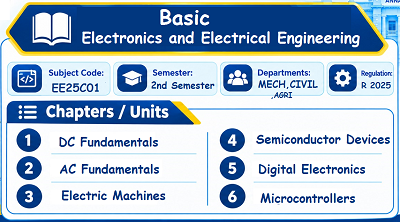
Basic Electrical and Electronics Engineering
EE25C01 2nd Semester | 2025 Regulation | 2nd Semester 2025 Regulation
Related Subjects
Professional English II
HS3251 2nd Semester 2021 Regulation | 2nd Semester Common to all Dept 2021 Regulation
Statistics and Numerical Methods
MA3251 2nd Semester 2021 Regulation M2 Engineering Mathematics 2 | 2nd Semester Common to all Dept 2021 Regulation
Engineering Graphics
GE3251 eg 2nd semester | 2021 Regulation | 2nd Semester Common to all Dept 2021 Regulation
Physics for Electrical Engineering
PH3202 2nd Semester 2021 Regulation | 2nd Semester EEE Dept 2021 Regulation
Basic Civil and Mechanical Engineering
BE3255 2nd Semester 2021 Regulation | 2nd Semester EEE Dept 2021 Regulation
Electric Circuit Analysis
EE3251 2nd Semester 2021 Regulation | 2nd Semester EEE Dept 2021 Regulation
Physics for Electronics Engineering
PH3254 - Physics II - 2nd Semester - ECE Department - 2021 Regulation | 2nd Semester ECE Dept 2021 Regulation
Electrical and Instrumentation Engineering
BE3254 - 2nd Semester - ECE Dept - 2021 Regulation | 2nd Semester ECE Dept 2021 Regulation
Circuit Analysis
EC3251 - 2nd Semester - ECE Dept - 2021 Regulation | 2nd Semester ECE Dept 2021 Regulation
Materials Science
PH3251 2nd semester Mechanical Dept | 2021 Regulation | 2nd Semester Mechanical Dept 2021 Regulation
Basic Electrical and Electronics Engineering
BE3251 2nd semester Mechanical Dept | 2021 Regulation | 2nd Semester Mechanical Dept 2021 Regulation
Physics for Civil Engineering
PH3201 2021 Regulation | 2nd Semester Civil Dept 2021 Regulation
Basic Electrical, Electronics and Instrumentation Engineering
BE3252 2021 Regulation | 2nd Semester Civil Dept 2021 Regulation
Physics for Information Science
PH3256 2nd Semester CSE Dept | 2021 Regulation | 2nd Semester CSE Dept 2021 Regulation
Basic Electrical and Electronics Engineering
BE3251 2nd Semester CSE Dept 2021 | Regulation | 2nd Semester CSE Dept 2021 Regulation
Programming in C
CS3251 2nd Semester CSE Dept 2021 | Regulation | 2nd Semester CSE Dept 2021 Regulation